
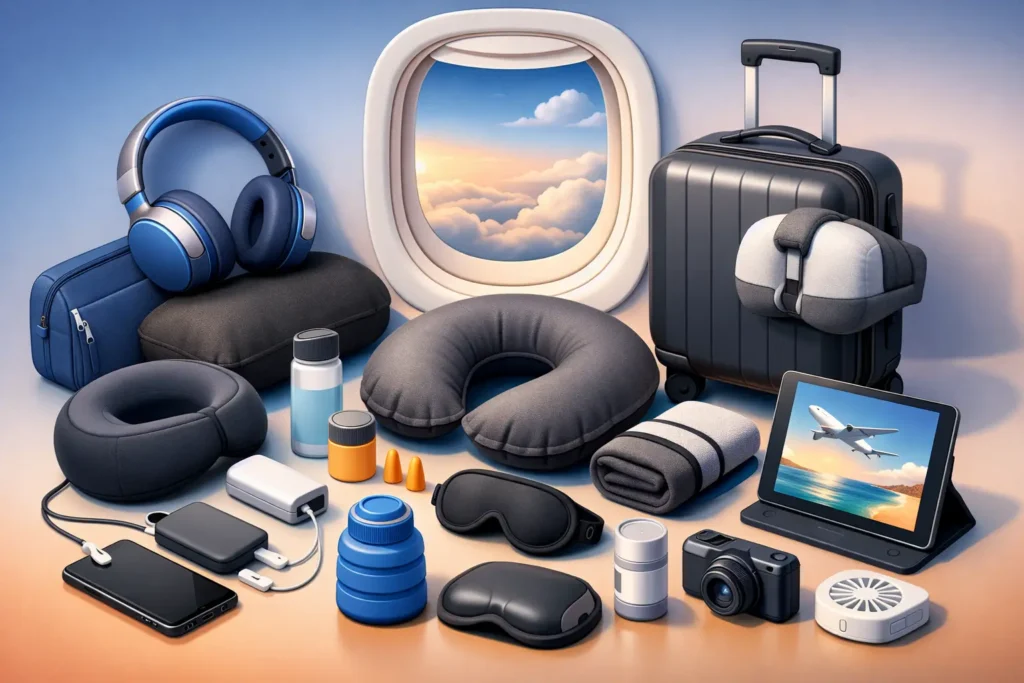
A cheap long-haul ticket feels like a heist until hour seven, when your neck is twisted, your phone is dying, and the guy in 32B has claimed both armrests like beachfront property. That is exactly why the right travel accessories for long flights matter. They do not need to be flashy or expensive. They just need to earn their spot in your carry-on.
The trick is not packing more. It is packing smarter. A few well-chosen items can turn a long flight from a survival exercise into something far more manageable, especially if you are trying to stretch a budget fare without paying for every little comfort upgrade.
What makes travel accessories for long flights worth buying?
Not every gadget belongs on a plane. Some accessories look clever online and end up being dead weight by boarding time. The best ones solve a real in-flight problem: bad sleep, dry air, tangled cords, dead batteries, cramped legs, or the chaos of digging through your personal item in a dark cabin.
If an item saves space, improves comfort, or helps you avoid buying overpriced airport replacements, it is pulling its weight. If it only sounds cool, leave it behind. Budget travelers already know the real flex is getting more value out of less.
Travel gear buying checklist: charging and sound
| Item | Compare before buying | When to skip the upgrade |
|---|---|---|
| Power bank for flights | Printed watt-hour rating, phone charging compatibility, output power, weight and your airline’s rules | Your existing charger already covers the trip and meets the applicable rules |
| Noise-canceling headphones | Comfort, battery life, wired fallback and compatibility with the aircraft’s entertainment connection | Compact earplugs or existing earbuds meet your needs |
| USB-C travel charger | Your devices’ required wattage, supported charging standards and output when several ports are in use | Your current charger already supports all the devices you are taking |
Can you bring a power bank on a plane?
Under FAA guidance, power banks must travel in carry-on baggage, not checked luggage. Units up to 100 Wh fall within the standard limit; larger units from 101–160 Wh require airline approval, with a limit of two spare units in that range. Airline and international restrictions can be stricter. Check the printed Wh rating and your carrier’s current rules before departure. See the FAA battery guidance.
What should I buy first for a long flight?
Start with the problem you expect to have: keeping your phone charged, sleeping, reducing noise or organizing your bag. Compare size, weight and compatibility before buying a bundle of gadgets. This guide offers selection criteria, not claims that we personally tested every item.
Traveling abroad? Our travel SIM and eSIM comparison helps you plan connectivity as well as charging.
The best travel accessories for long flights
1. A supportive neck pillow
This is the classic for a reason, but not all neck pillows are created equal. The cheap, floppy ones sold near the gate usually do one thing well: remind you that you should have packed a better one.
Look for support that keeps your head from snapping forward or sideways. Memory foam can feel great, but it takes up space. Inflatable versions pack smaller, though they are not always as stable. If you rarely sleep on planes, skip it. If you book red-eyes on purpose to save money and time, this one earns its keep fast.
2. Noise-canceling headphones or solid earplugs
Cabin noise is relentless. Engines hum, carts clatter, babies protest, and somebody always decides to watch a movie without understanding volume. Good audio gear can make a huge difference on long flights, especially when you are trying to sleep or focus.
Noise-canceling headphones are a bigger upfront spend, but they pay off if you fly often. Earplugs are the cheaper move and take up almost no room. If your budget is tight, a quality pair of wired earbuds plus earplugs is still a smart setup.
3. An eye mask that actually blocks light
A free airline eye mask is usually thin, slippery, and about as useful as putting a napkin over your face. A contoured eye mask that blocks light without pressing hard on your eyelids is a much better bet.
This matters most on overnight flights and routes with awkward timing, where your body clock is already losing the argument. If you are trying to arrive functional instead of wrecked, a real eye mask is one of the cheapest upgrades you can make.
4. A compact power bank
A seatback USB port is nice in theory. In reality, it may be slow, broken, or already claimed by your screen, your phone, and your growing distrust. A power bank gives you backup when outlets fail and airport charging stations are packed.
Choose one that is airline-compliant and slim enough to fit in your personal item pocket. You do not need the biggest brick on the market unless you are charging multiple devices. For most travelers, enough power for one to two full phone charges covers the pain points.
5. A charging cable pouch
Long flights expose messy packers. The moment you need a cable, adapter, or wired headphones, your bag turns into a scavenger hunt. A small organizer keeps cords, charging blocks, and travel adapters in one place.
This is not the most glamorous accessory, but it saves time and cuts stress. It also keeps you from replacing lost chargers at airport prices, which is never the deal-hunter move.
6. Compression socks
These are not exciting, but they are one of the smartest items on this list. Sitting for long stretches can leave your legs swollen, stiff, and generally annoyed with you. Compression socks help with circulation and can make a noticeable difference on long-haul routes.
They are especially useful if you are tall, prone to swelling, or flying overnight. No, they are not stylish. Neither is hobbling through immigration like your knees are 30 years older than the rest of you.
7. A refillable water bottle
Plane cabins are dry, and buying bottled water at the airport every time adds up. Bringing an empty refillable bottle through security and filling it before boarding is a simple money saver that also makes the flight more comfortable.
Choose a lightweight bottle that does not leak and fits easily in your bag pocket. Insulated bottles are nice, but they are heavier. For long flights, the best pick is usually the one you will actually carry.
8. Lip balm and a small moisturizer
Long flights are rough on skin. Airplane air dries out lips, hands, and face faster than most people expect, especially on overnight international routes. A basic lip balm and travel-size moisturizer solve an annoying problem before it becomes a bigger one.
You do not need a full skincare routine at 35,000 feet. Just pack the essentials that keep you comfortable. Bonus points if both items are under the liquid limit and easy to grab without unpacking half your bag.
9. A travel blanket or oversized scarf
Cabin temperatures are unpredictable. Sometimes it is stuffy at the gate and freezing once you are in the air. Airline blankets, when available, are hit or miss.
A packable travel blanket adds comfort, but an oversized scarf is more versatile and takes up less room. It can work as a blanket, pillow cover, or extra layer during chilly layovers. If you run cold, this is one accessory you will not regret carrying.
10. A foot hammock or footrest
This one depends on your height, seat space, and tolerance for extra setup. A portable footrest that hangs from the tray table can reduce lower back strain and make it easier to shift positions on a long flight.
It is most helpful for shorter travelers whose feet do not rest comfortably on the floor. If you are tall and already fighting for knee room, this may feel like one more thing in the way. Good accessory, wrong user, is still the wrong accessory.
11. A pill case with your flight basics
Headache relief, motion sickness tablets, allergy meds, and anything you personally rely on should stay in your carry-on, not your checked bag. A tiny pill case keeps them organized and easy to access.
This is one of those low-cost items that can save a flight. If turbulence hits, your sinuses act up, or your body decides now is the time for a migraine, you will be glad you planned ahead.
12. A smart personal item bag
The best accessory for a long flight may not be a gadget at all. It may be the bag that keeps everything else where you need it. A personal item with useful compartments can make boarding, security, and in-flight access much easier.
Look for a bag that slides under the seat, opens without a fight, and has separate spots for documents, devices, snacks, and comfort items. You should be able to grab what you need without standing in the aisle like you are unpacking for a week.
How to choose travel accessories for long flights without wasting money
The sweet spot is buying for the kind of traveler you are, not the fantasy version of yourself. If you almost never sleep on planes, a premium sleep setup may be overkill. If you always book the cheapest overnight route and arrive straight into a busy itinerary, comfort gear matters a lot more.
It also helps to think in layers. Start with your biggest pain point. Maybe it is sleep. Maybe it is staying charged. Maybe it is staying organized in a cramped seat. Fix that first, then build from there.
You also do not need to buy everything at once. A better carry-on setup often comes from a few affordable upgrades over time, especially if you travel enough to learn what actually annoys you in the air. That is a very FareBandit approach to gear – spend where it counts, skip the fluff, and keep more cash for the trip itself.
What to skip on a long flight
Some accessories create more hassle than comfort. Oversized pillows hog space. Bulky electronics can get heavy fast. Full-size toiletries are unnecessary. And any item that takes too long to set up in a tight economy seat is probably not as clever as it looked online.
Be especially careful with products that promise to solve every in-flight problem at once. Most all-in-one travel gadgets do several things badly instead of one thing well. For long flights, simple usually wins.
A long-haul flight is never going to feel like first class just because you packed well. But the right gear can help you land less tired, less cranky, and less tempted to overpay for comfort next time. That is a small win worth stealing.
