
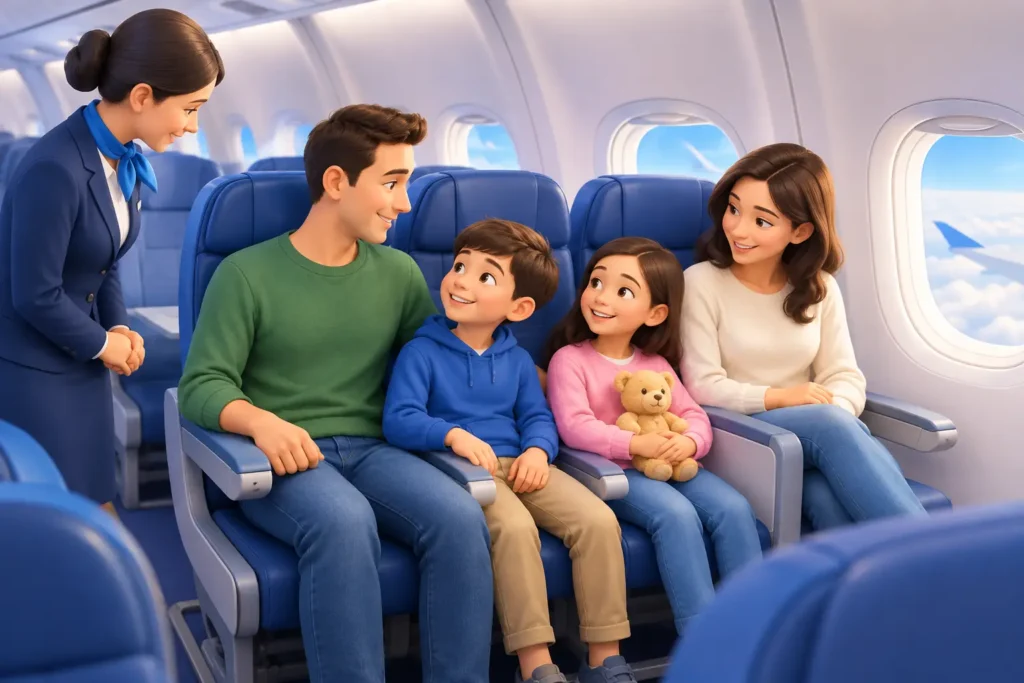
The fare looked like a steal – until the seat map put one parent in 12A, the other in 28D, and your 6-year-old somewhere in the middle. So, can airlines seat families together? Usually, yes, airlines can and often try to. But “try” is not the same thing as a guaranteed free row, especially on a packed flight or a bare-bones basic economy fare.
Here’s the deal: the smartest time to solve the family seating problem is before you click buy. A few booking moves can protect both your budget and your sanity, leaving more money for the beach, ballpark, or poker tournament instead of a last-minute seat-selection ransom.
Can airlines seat families together on U.S. flights?
Airlines control their seat maps, so they absolutely can assign families together when seats are available. The catch is that there has not historically been one simple, universal rule requiring every airline to seat every family together for free in every situation.
The U.S. Department of Transportation has pushed airlines to make family seating easier and has highlighted carrier commitments to seat a child age 13 or younger next to an accompanying adult at no additional cost when possible. Those commitments differ by airline, and the wording matters. Some promise adjacent seating when seats are available in the same cabin. Others may offer a nearby seat, rebook you on a different flight, or need you to contact customer service.
That means a family can be seated together without paying a seat fee, but it may depend on the airline, the fare you bought, the aircraft, and how late you booked. If an airline sells you a ticket, it does not automatically mean every seat choice remains free.
The practical answer is simple: do not assume a seat assignment will work itself out at the gate. Check the airline’s current family seating policy before booking, then look at the actual seat map before paying.
Why families get split up in the first place
Airlines sell seats in layers. The cheapest fare may get you on the plane, while preferred, extra-legroom, and standard assigned seats may carry different prices. By the time a family searches, the only adjacent options might be in a paid section or unavailable altogether.
Basic economy is often the troublemaker. On many airlines, it limits advance seat selection, delays it until check-in, or charges for it. That fare can still be a real bargain for a solo traveler with one backpack. For a parent traveling with young kids, the apparent savings can disappear if you later pay to sit together or accept a scattered seating arrangement.
A full flight is another culprit. If the airline has only single seats left, an agent cannot magically create a four-seat block. Aircraft swaps, schedule changes, and missed connections can also scramble seats that were originally together. Codeshare flights add one more wrinkle: the airline that sold the ticket may not be the airline operating the plane, and the operating carrier’s seating rules are the ones that count in practice.
Book the flight that gives your family a real shot
Price matters, but a deal is only a deal if it works for the whole crew. When comparing flights, pull up the seat map before you commit. If a cheaper itinerary has no adjacent seats and the next-best option does, compare the total cost after seat fees. Sometimes the “more expensive” flight is actually the better heist.
Book everyone on one reservation whenever possible. Separate confirmation numbers make it harder for an airline system to recognize that passengers are traveling together. If you need to use points for one traveler and cash for another, call the airline after booking and ask whether the reservations can be linked. Linking does not guarantee seats, but it gives an agent better context.
Nonstop flights help, too. Every connection is another seat map, another boarding process, and another chance for an aircraft change to cause chaos. A nonstop can be worth a few extra dollars when you are flying with toddlers, car seats, or a teenager whose definition of “nearby” is three rows away.
Pay for seats only when the math makes sense
There is no medal for refusing every add-on. If the airline offers two adjacent standard seats for a reasonable price and the trip is important, paying may be the cleanest answer. You are buying certainty, not just a seat number.
But do not pay blindly. First, check whether the airline’s family policy can handle the issue at no charge. Call or use the carrier’s chat support soon after booking, explain the ages of the children, and ask for adjacent seating. Keep the conversation polite and specific: give the record locator, flight number, and the seats currently assigned.
If the flight is lightly booked, waiting may work. If it is nearly full, involves very young children, or leaves during a peak holiday weekend, waiting is a gamble. Families do not need more travel roulette.
What to do after you book
Seat maps change constantly. Check your reservation right away, then check again after any schedule-change email. If better adjacent seats open up, move quickly. Airlines sometimes release more inventory closer to departure, especially after upgrades clear or travelers switch flights.
If you have been split up, contact the airline before travel day. Ask whether it can seat each child next to an adult in your party, even if the entire family cannot occupy one neat row. A parent and child in one row plus another parent and child directly behind is often a workable plan.
Arrive early if the problem is unresolved. A gate agent has more options before boarding begins than after half the plane is seated. Tell the agent you are traveling with children and show your existing assignments. Do not demand that another passenger be moved, though. Agents may ask for volunteers, but fellow travelers are not required to surrender the seat they selected or paid for.
Once onboard, a calm request can still help. Many passengers will gladly trade an aisle or middle seat so a young child can sit with a parent. The best swaps are fair swaps: offer the same type of seat or something better, and ask before people settle in. Never count on this as Plan A.
Ages, safety, and the details that change the answer
A lap infant does not need a seat assignment, but every adult has limits on how many lap infants they can hold. If you buy a seat for a baby or toddler and bring an approved car seat, check the airline’s rules on where it can be installed. Car seats generally cannot block another passenger’s exit, which can rule out certain rows.
For older kids, the airline may treat the situation differently than it would for a preschooler. A 14-year-old traveling with family is far more likely to be assigned nearby rather than directly beside a parent. If your child has a disability, sensory needs, medical equipment, or needs assistance during a flight, call early and explain what seating arrangement is necessary. Documentation or advance notice may help the airline arrange appropriate accommodations.
International trips can be trickier because the rules and carrier policies may differ from the U.S. standard. On an itinerary with multiple airlines, verify seats with each operating carrier. A confirmation email is not enough if no actual seat numbers appear beside every traveler.
When a schedule change breaks your seating plan
You picked seats, printed the confirmation, and then the airline changes the aircraft. Annoying? Absolutely. Unusual? Not really. A different plane may have a completely different cabin layout, and your carefully chosen row can vanish overnight.
When that happens, review the new assignments immediately. If they no longer work for your family, call rather than accepting the change in silence. Depending on the circumstances, the airline may be able to move you, rebook you on a flight with better seating, or refund seat-selection fees for seats it could not provide. Keep screenshots of the original seating and receipts for anything you paid.
The same approach applies after cancellations and missed connections. During disruption, speed matters. Get in the customer-service line while using the airline app or phone support. Ask for the next flight with seats that keep at least one adult beside each young child. The first available rebooking is not always the best rebooking.
The family-flight rule worth remembering
Can airlines seat families together? Yes. Will every cheap fare automatically produce a free, adjacent family row? No. Treat seat selection as part of the flight price, not a tiny detail to worry about later.
When you spot a low fare, check the cabin, seat map, fare rules, and total cost before grabbing it. FareBandit-style deal hunting is about stealing the best value, not just the lowest number on the first screen. A little seat-map detective work can keep your crew together and your travel budget pointed where it belongs: toward the fun waiting after landing.
